Showing posts with label videos. Show all posts

Monday, December 21, 2015

Grian-Stad Geamhraidh 2015

A Ghrian 1 translation ©kpn for Gaol Naofa

A Ghrian 2 translation ©kpn for Gaol Naofa

 Original images by Michael Kehoe and Susan

I changed very little from Carmichael's translation in the first half of this. Mostly I cut the "thees" and "thous". It's more in the second half where Carmichael's biases showed, in his choosing to translate "rìoghain òg" as "queenly maiden," whereas the meaning is more like "young queen" or "youthful queen."

As the goddesses with solar attributes are also associated with sovereignty,* this seems an odd change on his part. "Queenly Maiden" scans really well, though, so maybe poetic license also figured into it. One hopes. But it's not the only time Carmichael downgraded a goddess or spirit-woman this way. His collections of Gaelic prayers, songs, poetry and lore are invaluable, but between some sexism on his part and his atrocious handwriting, his translations always need to be checked. 


*At least in Áine's case. We really know very little about Grian. We are not even sure she was seen as a goddess. The idea of her being a goddess or powerful spirit-woman (and not just the name of the sun itself) is largely based on her having a hill near Áine's, and there being folklore that describes them as sisters. Beyond that, there are parallels in the Scottish "two suns" idea, so some of this is reconstructed and supported by shared visions, and not necessarily written in stone, per se. For more on Midwinter in the Gaelic lands, Áine and Grian, and our other main Scottish winter festival, Hogmanay, see our Winter playlist:

Saturday, October 24, 2015

Prophecy of the Morrígan - Memes for Samhain

Here in the mountains we've had our first snow shower, and our first hard freeze, so technically the festival of Samhain is here (despite it not yet being November).

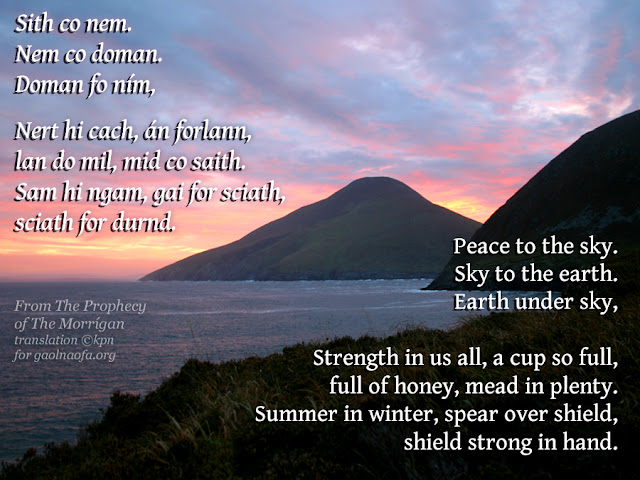
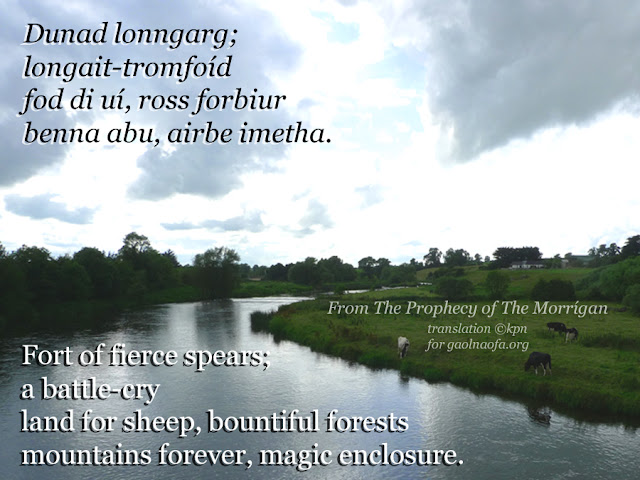
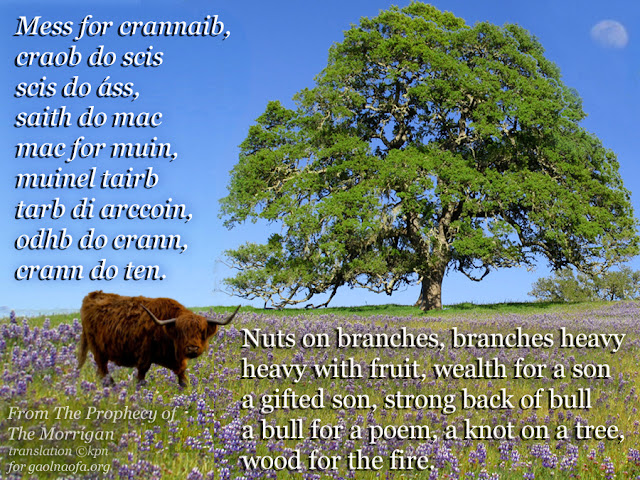
Annie and I have been continuing to make memes, and here are some I've done for the Prophecy. Links below to my full translation.

Prophecy meme – Number 1 - by Kathryn NicDhàna for Gaol Naofa 
Original image: Colin Whittaker

Prophecy meme – Section 2 - by Kathryn NicDhàna for Gaol Naofa 
Original image: Chad K

Prophecy meme – Section 3 - by Kathryn NicDhàna for Gaol Naofa 
Original images: Michael Kötter (coo) and Wikimedia Commons (background)

Prophecy meme – Section 4 - by Kathryn NicDhàna for Gaol Naofa 
Original image: Knowth.com (used with permission)

Prophecy meme – Section 5 - by Kathryn NicDhàna for Gaol Naofa
Original image: Moyan Brenn


The original Irish prayer here is from Cath Maige Tuired. 
For the full prayer in one piece, see my post from 2012, or the Gaol Naofa Memes page. For the fully-footnoted version exploring my translation of this traditional piece, see our Prayer in Gaelic Polytheism article.

In ancient Ireland, a great war is said to have taken place between the Tuatha Dé Danann and the Fomorians as they fought for the right to rule Ireland. The tale of this conflict is told in the Cath Maige Tuired (The Second Battle of Mag Tured), and the final battle took place Samhain, with the Tuatha Dé Danann being victorious.
Conflict, death and chaos are common themes associated with Samhain in Irish myth and folklore, but out of this conflict comes a resolution of peace. At the end of the Cath Maige Tuired, the Morrígan (or Badb) relates a rosc (a particular type of Irish poem, which is often written in obscure or archaic language), proclaiming victory in battle, and giving a prophecy of things to come. As Samhain approaches, it seems only appropriate to reflect on these themes, and the message of the Morrígan's words. As a prayer for peace, you might also wish to incorporate the words into your celebrations. The images collated here (five in all) each contain a section of the prayer. You can also view our video of it, which we released on our youtube channel last year:

Tuesday, September 29, 2015

Lá Fhéile Mhacha / Là Fhèill Mìcheil / Harvest

In honour of Là Fhèill Whatever, we've made an Autumn / Lá Fhéile Mhacha / Là Fhèill Mìcheil playlist, which includes several examples of earth-honouring, community traditions that survive in the present day. We have practical demonstrations of wheat-weaving (if you want to make a Cailleach figure for the harvest), the Cailleach an Dùdain (Old Woman of the Mill Dust) song, footage of the Riding of the Marches in Scotland, and of course the Seaweed Molly festival.


The Riding of the Marches is pretty clearly about boundaries - namely the practical act of checking the fences and edges of the territory, and perhaps there's also something spiritual here. At Samhain, hard choices - literally life and death - need to be made by those who raise livestock; Samhain is traditionally the time to decide how many animals can make it through the winter, and how many are going to be slaughtered for meat. At this festival, those who farm are bringing in the last of the grain, so this figures into the winter planning as well, and is clearly symbolized by the slowest person to finish the harvest having to support the Cailleach for the coming winter. It would also make sense that those with the largest fields need more time to bring all the grain in, so this tradition could be a way of recognizing that personal abundance calls for community responsibility - if you have more than you need, proper hospitality and honour leads one to want to share that abundance with those who don't have enough. And maybe having your neighbors toss the Cailleach at you is a way of making sure everyone upholds that bargain.

The Seaweed Molly rite is about giving back to the sea - making an offering of gratitude and thanks that the sea spirits have been kind this year, and not taken back (drowned) any people from the community. I also find it touching that the modern survival has these young surfers and lifeguards carrying the Molly doll (much like a Brideóg) from door to door and recieving honours and gifts for their part in maintaining community safety: Another safe year of swimming in the sea. How fitting that they then paddle out to make the offerings to the spirits on behalf of the community that they help protect.

Slàinte Mhath! 

For more detail on all of the above, see our other recent posts over at the Gaol Naofa Facebook page.

‪

Monday, August 24, 2015

New Video - Offerings in Gaelic Polytheism


We've been getting visual :)

More details about the offerings video on our YouTube channel, and in an update over on the Gaol Naofa website.

Gaol Naofa - Dùrachd
Photo credit: John McSporran, used under Creative Commons Licence.

We update more frequently over at our Facebook page, so if you haven't, come visit us there. :)

Friday, February 20, 2015

Mooon. Sacred.

Some Gaol Naofa website updates and another video. This is supposed to be one of those new moons that, once visible, will be larger-looking than usual, low on the horizon. Haven't seen it yet. Go look outside at sunset and see if you can spot it.


(thanks to Ryan for the title. ;) )

Sunday, February 01, 2015

Là Fhèill Brìghde 2015

This has been a busy Imbolc, so this will be brief. Here's our Là Fhèill Brìghde video. We made this last spring, so this is the first time we've had it for the festival day.


We've been continuing to work on the missing Manannán situation, and will have more materials out shortly.  For Imbolc proper, Annie got it together in the midst of it all to post Là Fhèill Brìghde links and stuff, as well as some lovely photos of Brigid's well and environs at her sanctuary in Kildare. Check 'em out, and we'll be back shortly.


Friday, January 30, 2015

Singing Manannán Home - New Video and Memes

image composite by Gaol Naofa at gaolnaofa.org

The search for the Limavady Manannán statue continues. As Gaelic Polytheists, as people involved in cultural preservation, we are continuing to assist the effort, via networking and raising the alert via the Gaol Naofa and CAORANN pages on Facebook and Twitter (Gaol Naofa Twitter, CAORANN Twitter), and now with a new video and some more memes.


For this video we have compiled some of the many, astonishingly beautiful photos of the statue and land in Limavady, County Derry, Ireland (Léim an Mhadaidh, Co. Dhoire, Éire), plus a prayer we are using to call Manannán home. This video also has the Manx lyrics synched up with the corresponding verses in the song, to better facilitate learning.

We are calling Manannán from wherever he is, to show himself in the world, and to reveal the whereabouts of the statue. If the statue has been destroyed, we will support efforts to have it replaced. But it is up to the people of Limavady, and the sculptor, John Darren Sutton. The Limavady town council has expressed interest in replacing it themselves. After all, they originally commissioned the piece as part of their sculpture and heritage trail. If their budget will not adequately cover a replacement, we have also promised to help with any needed fundraising. While it's impressive to see the worldwide attention on this, those of us in the diaspora need to remember that any fundraising - if it is even necessary - needs to go through the local community in Ireland, specifically the Limavady community, and not through any individual from outside that community.

These amazing photos were largely collected via the Facebook group, Bring back Manannan Mac Lir the Sea God.  All the photographs in the video and memes are used with permission from, and gratitude to, the photographers (see the video credits for the full list of participants). Feel free to share them to keep the search for the stolen statue on the front burner.

The theft continues to get a great deal of press in Ireland and worldwide, and in specialized media like The Wild Hunt, who quote Annie and mention our work with Gaol Naofa:  Calling Manannan mac Lir Back Home.  

See the update on the Gaol Naofa site for full details: Where is Manannán?

text copyright ©2015 Kathryn NicDhàna for Gaol Naofa and gaolnaofa.org

Monday, December 15, 2014

Grianstad an Gheimhridh (Winter Solstice) and Hogmanay

Fàs is gnàths is toradh
growth, tradition, success 
Image copyright ©2014 Kathryn Price NicDhàna
On Hogmanay morn, we gather water from under the bridge, which became
"a dead and living ford" the first time we brought a deer carcass across,
and which has now witnessed the passage of several of our beloved dead. 
photo copyright ©2014 kpn

The winter snows have come, the nights are long and cold. We gather with our loved ones and hold each other close.

Yes, we've made more Gaol Naofa videos :)  Annie took point on these, and we have her lovely photos from Newgrange and other sacred sites in Ireland and Scotland. For those of Scottish heritage who may not have known why secular/calendar New Year's Eve is a big deal in our families of origin, we have the answer: Hogmanay.

Hogmanay is a time for saining the house and welcoming in the New Year. While the dour Celtic mindset supports the idea of beginning the year at the falling darkness of Samhain, there is something about the Winter Solstice sunrise that lights a spark in my heart: The longest night of the year is broken by the rising sun, shining down the long passage at Brú na Bóinne, bringing light to the ancestors and announcing that now the days will grow longer, bit by bit, until warmth and green return to the land.


As a people who see time as a circle, and spirit as eternal while only matter rises and falls, dies and is born again, I'm not particularly interested in the debates about which day is "The Celtic New Year." Arguments can be made for pretty much any point in the cycle, depending on one's work, where one lives, and which deities and spirits are most important to us. 

The phrase  "Fàs is gnàths is toradh (Growth, custom, and fertility)" is traditionally said by the head of the household as they bring a twig from a local fruit-bearing tree inside to the breakfast feast. It is customary to sain one another and entire house at this time, with water from "a dead and living ford" (a watercourse over which both the living and dead pass), and to fill the house with so much juniper smoke that everyone begins to cough. This means that all your smoke alarms will also be going off. I consider it part of the festivities. But any of the alarms that are hooked into a security system will need to be turned off. Trust me, your local firefighters will appreciate being spared the false alarm. If you forget and they show up anyway, you can consider it a bizarre variation on first-footing. Make sure to offer them abundant hospitality.


As everyone is coughing and the alarms are blaring, it is time to fling open the doors and windows and welcome in the brisk, cold air of New Year's morning. We do a brief welcome and prayer in Gaelic at each door and window we fling open, welcoming the household's guardian spirits and the qualities we hope for in the coming year. It is customary at this time for the hearthkeeper of the household to offer everyone a nip of whisky. As a sober household, we use strong, alder-roasted or hazelnut coffee and espresso chocolate.

Then everyone sits down to a big breakfast, which symbolizes the abundance we hope for in the coming year.

Good Hogmanay to our Gaol Naofa family and extended community!
Fàs is gnàths is toradh!


For an abundance of lore and more suggestions for celebrations, see Annie's collection of links to her articles and research. 


Tuesday, September 30, 2014

Samhain

And we have... another video. This time on Samhain, with songs, poems, prayers and activities:


Annie did a good writeup about the videos, so I'll just send you her way. We also have some updates on the Gaol Naofa page.

 Blessed Samhain to you all!

Saturday, July 26, 2014

And... MORE videos

Annie and I have been busy. Thanks also to our Gaol Naofa community, who have shared their photos and music, posed for photos, made coffee, driven us to wifi spots while we stared at our laptops, given vital feedback and spotted typos. We're having fun doing these, and have more to come.

This batch includes Lúnasa /Taillte, The Prophecy of the Morrígan, and La Fheill Micheil. For more about the videos, see our blurb on the website, discussion in our various online communities, and our channel itself (notably the Festivals playlist).

Slàn!

Lúnasa  / Taillte


The Prophecy of the Morrígan


Là Fhèill Mìcheil (with customs for Autumn, Lugh, Manannán and Macha)


ETA: Annie goes into more background on the conditions of peace at Lúnasa, and the importance of this tradition in her post.

Tuesday, July 08, 2014

Gaelic Polytheist Videos - Lá Fhéile Bríde, Là na Caillich, Bealtaine, Áine agus Grian, & Manannán

We've been busy at Gaol Naofa! Along with all the usual activities of summer, we've made some more videos. Here are five more in the series, focusing on the seasonal and local festivals.

We had fun making these, and hope they can provide a brief intro to the subject for those less inclined to read a 90 page article or scholarly book. Additionally, we've dedicated our efforts to capturing the essence of each topic in visuals and music in a way bare words cannot. After all, the lore says we must drink from all five streams of knowledge, and engage all the senses in absorbing the sacred.

Images are mostly of the sacred sites and activities associated with each of the deities, spirits and festivals. Music is either an old, traditional song on the topic, or a contemporary version of traditional lyrics and tunes. Traditional prayers are included. Some of these images are old, archival photos, others were taken very recently by our members in the Celtic Nations and diaspora (in some cases photographed expressly for this series). Much gratitude to all our friends and relatives who went trekking with their cameras in tow!

Feel free to share!

Lá Fhéile Bríde — The Festival Day of Bríd
As the sun sets on the last day of January, the goddess Brigid walks the land, bringing the first stirrings of spring. Even if the ground is still covered in snow, the earth begins to stir from her long winter sleep.


Là na Caillich — The Day of the Hag
Spring is starting to happen around us, and the Clumsy Old Woman who Shapes the World is stirring up the last of the winter storms, and considering lying down for a bit of a nap. Sometimes when she does this, she accidentally creates a river or loch. Other times she drops stones she's carrying and, Ooops, another mountain range appears. She's had a lot on her mind, and wants to take a break. 


Bealtaine
In the Celtic lands, the summer is here. When the hawthorn blooms, it's warm enough to move the flocks and the herds, and hold bonfires welcoming the light half of the year. Readers of this blog will recognize the song here. 


Midsummer — Áine agus Grian
The Celts do not have a "sun deity" in the way Classical mythology would frame it. Instead, our deities and spirits are multifaceted, with full personalities, like the people they watch over, like the ancestors some of them once were. (And still are, for many of us.) In the Gaelic areas, as in most Celtic cultures, the fire festivals of Samhain, Imbolc, Bealtaine and Lúnasa are the major festivals. Activities and beliefs connected with the solstices and equinox tend to be based either on older, pre-Celtic remnants that survived in some form as local festivals, or on imports that came with the Norse and were syncretised with local beliefs and customs. Not all communities acknowledge these solar phenomena, at all, but those that do tend to associate them with beloved local spirits, often those of sovereignty.


Manannán — Paying the Rents at Midsummer

Mac Lir, son of the sea, patron of the Isle of Man, guiding spirit of Gaelic Polytheism. Well, one of them. But Manannán has shown an especial interest in the development of Celtic Reconstructionism, and I am happy to have this lovely video about him and his work, an homage and thank you for the guidance he's provided us over the decades.

Wednesday, March 12, 2014

Lá Fhéile Pádraig / "Saint" "Patrick's" Day, 2014

Tis the Season...

For those of us with Irish heritage in the diaspora, this is one of the most awkward and uncomfortable times of the year. While we are relieved at the lengthening days and warming weather, glad to have survived another harsh winter, we are also horrified at the debacle that is American and Canadian Saint Patrick's day.

As I write this, the riots have started. In one college town this weekend, thousands of students celebrated their idea of St. Patrick's day by drinking themselves sick, puking on their violent green t-shirts, assaulting one another and hurling bottles and rocks at the riot police that tried to stop them from harming other civilians. This behaviour is shameful, and as an Irish-American it makes me very sad and dismayed to see this happening yet again in the name of "Irish pride." Of course, I think only a minority of those rioters even have Irish heritage. And what heritage they have, they dishonour.

As I've written about before, to attend some of these awful festivities can put your safety in jeopardy. And the thing is, these drunken blowouts have nothing to do with being Irish.

In past years, we've done our best to avoid the whole thing, or to quietly educate via online discussion and memes.

This year, we've decided to get proactive.


We're pleased to present an article debunking some of the myths around St. Patrick's Day: Pagans, Polytheists, and St Patrick’s Day, as well as two videos on the topic.

Video one is a general introduction to the problems with the stereotypes, and video two is directed more specifically at the myths around Patrick himself, and the misinformation spread by both Pagans and Christians.


Our Gaol Naofa video channel has been in the works for a while now. Treasa made our first videos two years ago, then we stalled out a bit on getting more done. This year we've tried to use our anger and frustration around the whole St. Paddy's thing to motivate us to finish up some projects and counter the misinformation. Check out our playlists for other videos that should be of interest to Gaelic Polytheists, or anyone interested in Celtic Reconstructionism and Gaelic cultures in general. If you like what you see, feel free to subscribe, as more is in the works.

As we say in the videos, we welcome the spring, and celebrate the Hag who turns the seasons. She, and the Earth, are renewing themselves now, and we honour her.

We also honour our ancestors who worked so hard to survive oppression, famine and exile. The St. Paddy's parades in the diaspora initially began as cultural celebrations - a day for members of an oppressed ethnicity to gather together and celebrate their survival against the odds. It was only after our recent ancestors "became white" and rose to power in the police departments and mainstream politics that the marches became drunken bacchanals, with little to no connection to anything traditionally Irish.

We hope you enjoy these contributions, and find them useful in debunking the myths that surround this season. For more on our recent projects (such as our in-depth article, “Children and Family in Gaelic Polytheism”), see the Gaol Naofa site. Sláinte Mhaith.