(thanks to Ryan for the title. ;) )
Showing posts with label Ceòl Traidiseanta. Show all posts
Showing posts with label Ceòl Traidiseanta. Show all posts
Friday, February 20, 2015
Mooon. Sacred.
Some Gaol Naofa website updates and another video. This is supposed to be one of those new moons that, once visible, will be larger-looking than usual, low on the horizon. Haven't seen it yet. Go look outside at sunset and see if you can spot it.
(thanks to Ryan for the title. ;) )
(thanks to Ryan for the title. ;) )


Friday, January 30, 2015
Singing Manannán Home - New Video and Memes

The search for the Limavady Manannán statue continues. As Gaelic Polytheists, as people involved in cultural preservation, we are continuing to assist the effort, via networking and raising the alert via the Gaol Naofa and CAORANN pages on Facebook and Twitter (Gaol Naofa Twitter, CAORANN Twitter), and now with a new video and some more memes.
For this video we have compiled some of the many, astonishingly beautiful photos of the statue and land in Limavady, County Derry, Ireland (Léim an Mhadaidh, Co. Dhoire, Éire), plus a prayer we are using to call Manannán home. This video also has the Manx lyrics synched up with the corresponding verses in the song, to better facilitate learning.
We are calling Manannán from wherever he is, to show himself in the world, and to reveal the whereabouts of the statue. If the statue has been destroyed, we will support efforts to have it replaced. But it is up to the people of Limavady, and the sculptor, John Darren Sutton. The Limavady town council has expressed interest in replacing it themselves. After all, they originally commissioned the piece as part of their sculpture and heritage trail. If their budget will not adequately cover a replacement, we have also promised to help with any needed fundraising. While it's impressive to see the worldwide attention on this, those of us in the diaspora need to remember that any fundraising - if it is even necessary - needs to go through the local community in Ireland, specifically the Limavady community, and not through any individual from outside that community.
These amazing photos were largely collected via the Facebook group, Bring back Manannan Mac Lir the Sea God. All the photographs in the video and memes are used with permission from, and gratitude to, the photographers (see the video credits for the full list of participants). Feel free to share them to keep the search for the stolen statue on the front burner.
The theft continues to get a great deal of press in Ireland and worldwide, and in specialized media like The Wild Hunt, who quote Annie and mention our work with Gaol Naofa: Calling Manannan mac Lir Back Home.
See the update on the Gaol Naofa site for full details: Where is Manannán?

Monday, December 15, 2014
Grianstad an Gheimhridh (Winter Solstice) and Hogmanay
Fàs is gnàths is toradh
growth, tradition, success
growth, tradition, success
 |
On Hogmanay morn, we gather water from under the bridge, which became
"a dead and living ford" the first time we brought a deer carcass across, and which has now witnessed the passage of several of our beloved dead. photo copyright ©2014 kpn |
The winter snows have come, the nights are long and cold. We gather with our loved ones and hold each other close.
Yes, we've made more Gaol Naofa videos :) Annie took point on these, and we have her lovely photos from Newgrange and other sacred sites in Ireland and Scotland. For those of Scottish heritage who may not have known why secular/calendar New Year's Eve is a big deal in our families of origin, we have the answer: Hogmanay.
Hogmanay is a time for saining the house and welcoming in the New Year. While the dour Celtic mindset supports the idea of beginning the year at the falling darkness of Samhain, there is something about the Winter Solstice sunrise that lights a spark in my heart: The longest night of the year is broken by the rising sun, shining down the long passage at Brú na Bóinne, bringing light to the ancestors and announcing that now the days will grow longer, bit by bit, until warmth and green return to the land.
As a people who see time as a circle, and spirit as eternal while only matter rises and falls, dies and is born again, I'm not particularly interested in the debates about which day is "The Celtic New Year." Arguments can be made for pretty much any point in the cycle, depending on one's work, where one lives, and which deities and spirits are most important to us.
The phrase "Fàs is gnàths is toradh (Growth, custom, and fertility)" is traditionally said by the head of the household as they bring a twig from a local fruit-bearing tree inside to the breakfast feast. It is customary to sain one another and entire house at this time, with water from "a dead and living ford" (a watercourse over which both the living and dead pass), and to fill the house with so much juniper smoke that everyone begins to cough. This means that all your smoke alarms will also be going off. I consider it part of the festivities. But any of the alarms that are hooked into a security system will need to be turned off. Trust me, your local firefighters will appreciate being spared the false alarm. If you forget and they show up anyway, you can consider it a bizarre variation on first-footing. Make sure to offer them abundant hospitality.
As everyone is coughing and the alarms are blaring, it is time to fling open the doors and windows and welcome in the brisk, cold air of New Year's morning. We do a brief welcome and prayer in Gaelic at each door and window we fling open, welcoming the household's guardian spirits and the qualities we hope for in the coming year. It is customary at this time for the hearthkeeper of the household to offer everyone a nip of whisky. As a sober household, we use strong, alder-roasted or hazelnut coffee and espresso chocolate.
Then everyone sits down to a big breakfast, which symbolizes the abundance we hope for in the coming year.
Good Hogmanay to our Gaol Naofa family and extended community!
Fàs is gnàths is toradh!
For an abundance of lore and more suggestions for celebrations, see Annie's collection of links to her articles and research.
Good Hogmanay to our Gaol Naofa family and extended community!
Fàs is gnàths is toradh!
For an abundance of lore and more suggestions for celebrations, see Annie's collection of links to her articles and research.
Tuesday, September 30, 2014
Samhain
And we have... another video. This time on Samhain, with songs, poems, prayers and activities:
Annie did a good writeup about the videos, so I'll just send you her way. We also have some updates on the Gaol Naofa page.
Blessed Samhain to you all!
Annie did a good writeup about the videos, so I'll just send you her way. We also have some updates on the Gaol Naofa page.
Blessed Samhain to you all!
Saturday, July 26, 2014
And... MORE videos
Annie and I have been busy. Thanks also to our Gaol Naofa community, who have shared their photos and music, posed for photos, made coffee, driven us to wifi spots while we stared at our laptops, given vital feedback and spotted typos. We're having fun doing these, and have more to come.
This batch includes Lúnasa /Taillte, The Prophecy of the Morrígan, and La Fheill Micheil. For more about the videos, see our blurb on the website, discussion in our various online communities, and our channel itself (notably the Festivals playlist).
Slàn!
Lúnasa / Taillte
The Prophecy of the Morrígan
Là Fhèill Mìcheil (with customs for Autumn, Lugh, Manannán and Macha)
ETA: Annie goes into more background on the conditions of peace at Lúnasa, and the importance of this tradition in her post.
This batch includes Lúnasa /Taillte, The Prophecy of the Morrígan, and La Fheill Micheil. For more about the videos, see our blurb on the website, discussion in our various online communities, and our channel itself (notably the Festivals playlist).
Slàn!
Lúnasa / Taillte
The Prophecy of the Morrígan
Là Fhèill Mìcheil (with customs for Autumn, Lugh, Manannán and Macha)
ETA: Annie goes into more background on the conditions of peace at Lúnasa, and the importance of this tradition in her post.
Tuesday, July 08, 2014
Gaelic Polytheist Videos - Lá Fhéile Bríde, Là na Caillich, Bealtaine, Áine agus Grian, & Manannán
We've been busy at Gaol Naofa! Along with all the usual activities of summer, we've made some more videos. Here are five more in the series, focusing on the seasonal and local festivals.
We had fun making these, and hope they can provide a brief intro to the subject for those less inclined to read a 90 page article or scholarly book. Additionally, we've dedicated our efforts to capturing the essence of each topic in visuals and music in a way bare words cannot. After all, the lore says we must drink from all five streams of knowledge, and engage all the senses in absorbing the sacred.
Images are mostly of the sacred sites and activities associated with each of the deities, spirits and festivals. Music is either an old, traditional song on the topic, or a contemporary version of traditional lyrics and tunes. Traditional prayers are included. Some of these images are old, archival photos, others were taken very recently by our members in the Celtic Nations and diaspora (in some cases photographed expressly for this series). Much gratitude to all our friends and relatives who went trekking with their cameras in tow!
Feel free to share!
Lá Fhéile Bríde — The Festival Day of Bríd
As the sun sets on the last day of January, the goddess Brigid walks the land, bringing the first stirrings of spring. Even if the ground is still covered in snow, the earth begins to stir from her long winter sleep.
Là na Caillich — The Day of the Hag
Spring is starting to happen around us, and the Clumsy Old Woman who Shapes the World is stirring up the last of the winter storms, and considering lying down for a bit of a nap. Sometimes when she does this, she accidentally creates a river or loch. Other times she drops stones she's carrying and, Ooops, another mountain range appears. She's had a lot on her mind, and wants to take a break.
Bealtaine
In the Celtic lands, the summer is here. When the hawthorn blooms, it's warm enough to move the flocks and the herds, and hold bonfires welcoming the light half of the year. Readers of this blog will recognize the song here.
Midsummer — Áine agus Grian
The Celts do not have a "sun deity" in the way Classical mythology would frame it. Instead, our deities and spirits are multifaceted, with full personalities, like the people they watch over, like the ancestors some of them once were. (And still are, for many of us.) In the Gaelic areas, as in most Celtic cultures, the fire festivals of Samhain, Imbolc, Bealtaine and Lúnasa are the major festivals. Activities and beliefs connected with the solstices and equinox tend to be based either on older, pre-Celtic remnants that survived in some form as local festivals, or on imports that came with the Norse and were syncretised with local beliefs and customs. Not all communities acknowledge these solar phenomena, at all, but those that do tend to associate them with beloved local spirits, often those of sovereignty.
Manannán — Paying the Rents at Midsummer
Mac Lir, son of the sea, patron of the Isle of Man, guiding spirit of Gaelic Polytheism. Well, one of them. But Manannán has shown an especial interest in the development of Celtic Reconstructionism, and I am happy to have this lovely video about him and his work, an homage and thank you for the guidance he's provided us over the decades.
We had fun making these, and hope they can provide a brief intro to the subject for those less inclined to read a 90 page article or scholarly book. Additionally, we've dedicated our efforts to capturing the essence of each topic in visuals and music in a way bare words cannot. After all, the lore says we must drink from all five streams of knowledge, and engage all the senses in absorbing the sacred.
Images are mostly of the sacred sites and activities associated with each of the deities, spirits and festivals. Music is either an old, traditional song on the topic, or a contemporary version of traditional lyrics and tunes. Traditional prayers are included. Some of these images are old, archival photos, others were taken very recently by our members in the Celtic Nations and diaspora (in some cases photographed expressly for this series). Much gratitude to all our friends and relatives who went trekking with their cameras in tow!
Feel free to share!
Lá Fhéile Bríde — The Festival Day of Bríd
As the sun sets on the last day of January, the goddess Brigid walks the land, bringing the first stirrings of spring. Even if the ground is still covered in snow, the earth begins to stir from her long winter sleep.
Là na Caillich — The Day of the Hag
Spring is starting to happen around us, and the Clumsy Old Woman who Shapes the World is stirring up the last of the winter storms, and considering lying down for a bit of a nap. Sometimes when she does this, she accidentally creates a river or loch. Other times she drops stones she's carrying and, Ooops, another mountain range appears. She's had a lot on her mind, and wants to take a break.
Bealtaine
In the Celtic lands, the summer is here. When the hawthorn blooms, it's warm enough to move the flocks and the herds, and hold bonfires welcoming the light half of the year. Readers of this blog will recognize the song here.
Midsummer — Áine agus Grian
The Celts do not have a "sun deity" in the way Classical mythology would frame it. Instead, our deities and spirits are multifaceted, with full personalities, like the people they watch over, like the ancestors some of them once were. (And still are, for many of us.) In the Gaelic areas, as in most Celtic cultures, the fire festivals of Samhain, Imbolc, Bealtaine and Lúnasa are the major festivals. Activities and beliefs connected with the solstices and equinox tend to be based either on older, pre-Celtic remnants that survived in some form as local festivals, or on imports that came with the Norse and were syncretised with local beliefs and customs. Not all communities acknowledge these solar phenomena, at all, but those that do tend to associate them with beloved local spirits, often those of sovereignty.
Manannán — Paying the Rents at Midsummer
Mac Lir, son of the sea, patron of the Isle of Man, guiding spirit of Gaelic Polytheism. Well, one of them. But Manannán has shown an especial interest in the development of Celtic Reconstructionism, and I am happy to have this lovely video about him and his work, an homage and thank you for the guidance he's provided us over the decades.
Wednesday, July 25, 2012
The Western Isles
Here is a fabulous little film, a true treasure from the archives.
Set in the Hebrides during WWII, it features Gàidhlig speakers, some lovely waulking songs (Òran Luaidh), and sumptuous footage of the sea and islands. With the focus on a household who make Harris tweed, those in our communities who carry on the spinning and weaving traditions should enjoy this as well.
Read more about the film here.
Moran Taing to Tobar an Dualchais for sharing this!
The òran luaidh are a great source of inspiration to those of us with women's circles. Their call and response style, with a woman leading with improvised verses, and a group of women repeating the chorus, were historically used to share gossip, community lore, and personal stories. Traditionally, they were for women only, though some modern language preservation groups have everyone sing the songs now. Such as in this version of an òran luadh, adapted for instrumentation and a mixed group:
Karen Matheson: "Chuir m'Athair Mise Dha'n Taigh Charraideach" (còmhla ri "Seudan a'Chuain")
For both Gaelic Polytheists and Gaelic Christians, this kind of structure is also used for some types of prayer and ceremony. It's a specifically Gaelic women's approach, yet the form is also found in the song-prayers of a number of different animistic cultures. For more on prayers that take this form, check out the latter volumes in particular of the Carmina Gadelica (Gàidhlig: Ortha nan Gàidheal). The full set of the Carmina is expensive, but there is also interlibrary loan. Most good University libraries have a copy, and it's essential to any Gaelic studies program. The first volumes are available online at a few sites, as well.
The article above mentions the film, I Know Where I’m Going!, also shot in the Hebrides (but in black and white), and featuring our beloved Coire Bhreacain, Cauldron of the Hag. (English: the Corryvreckan Whirlpool.) I Know Where I’m Going! is also interesting for its footage of the isles and sea, but focuses more on the protagonist and her romantic life than Gaelic culture. Still, worth checking out if you like quirky old movies.
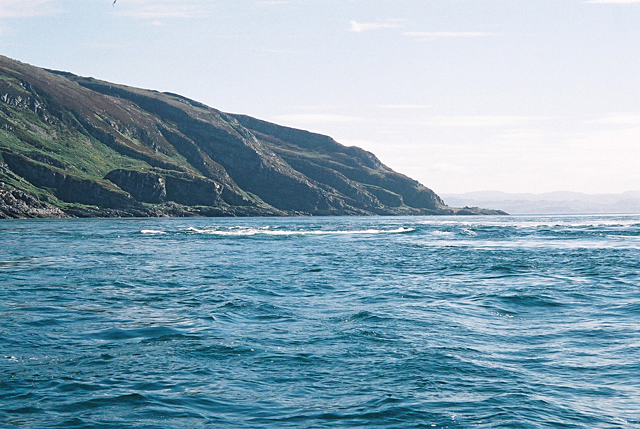
photo by russ baum
Set in the Hebrides during WWII, it features Gàidhlig speakers, some lovely waulking songs (Òran Luaidh), and sumptuous footage of the sea and islands. With the focus on a household who make Harris tweed, those in our communities who carry on the spinning and weaving traditions should enjoy this as well.
Read more about the film here.
Moran Taing to Tobar an Dualchais for sharing this!
The òran luaidh are a great source of inspiration to those of us with women's circles. Their call and response style, with a woman leading with improvised verses, and a group of women repeating the chorus, were historically used to share gossip, community lore, and personal stories. Traditionally, they were for women only, though some modern language preservation groups have everyone sing the songs now. Such as in this version of an òran luadh, adapted for instrumentation and a mixed group:
Karen Matheson: "Chuir m'Athair Mise Dha'n Taigh Charraideach" (còmhla ri "Seudan a'Chuain")
For both Gaelic Polytheists and Gaelic Christians, this kind of structure is also used for some types of prayer and ceremony. It's a specifically Gaelic women's approach, yet the form is also found in the song-prayers of a number of different animistic cultures. For more on prayers that take this form, check out the latter volumes in particular of the Carmina Gadelica (Gàidhlig: Ortha nan Gàidheal). The full set of the Carmina is expensive, but there is also interlibrary loan. Most good University libraries have a copy, and it's essential to any Gaelic studies program. The first volumes are available online at a few sites, as well.
The article above mentions the film, I Know Where I’m Going!, also shot in the Hebrides (but in black and white), and featuring our beloved Coire Bhreacain, Cauldron of the Hag. (English: the Corryvreckan Whirlpool.) I Know Where I’m Going! is also interesting for its footage of the isles and sea, but focuses more on the protagonist and her romantic life than Gaelic culture. Still, worth checking out if you like quirky old movies.

photo by russ baum
Saturday, July 21, 2012
Óró 'Sé Do Bheatha 'Bhaile
In a recent discussion about trad songs for summertime, I was surprised to see I hadn't posted anything here about Óró 'Sé Do Bheatha 'Bhaile. This is one of my favorites, not only for its history as a Rebel song (in a series of Rebellions), but also as it's about Sovereignty. Which Warrior Queen is being called to? What does it mean to welcome her home?
As the refrain ends, "Now that summer is coming," seasonally this is more appropriate for Spring. But I find that it often crops up in the river of song when a welcome is called for. Sláinte Mhaith!
The Wikipedia article on the song is pretty good, and has some of the alternate versions. This is my preferred variation, adapted by Pádraig Pearse:
Gaeilge:
'Sé do bheatha, a bhean ba léanmhar,
Do b' é ár gcreach tú bheith i ngéibheann,
Do dhúiche bhreá i seilbh méirleach,
Is tú díolta leis na Gallaibh.
Curfá:
Óglaigh armtha léi mar gharda,
Gaeil iad féin is ní Frainc ná Spáinnigh,
Is cuirfidh siad ruaig ar Ghallaibh.
Mura mbeam beo ina dhiaidh ach seachtain,
Gráinne Mhaol agus míle gaiscíoch,
Ag fógairt fáin ar Ghallaibh.
English:
Welcome oh woman who was so afflicted,
It was our ruin that you were in bondage,
Our fine land in the possession of thieves
And you sold to the foreigners!
Chorus:
Armed warriors along with her as her guard,
They are Gaels, not French nor Spanish
And they will rout the foreigners!
Although we may live for a week once after,
Gráinne Mhaol and a thousand warriors
Dispersing the foreigners!
Notes
1Original: "Rí na bhFeart - King of Miracles," usually interpreted as the Christian God, altered here to "Rígan na bhFeart - Queen of Miracles," in honor of Sovereignty, who in Irish lore is always personified as a woman. There is a great tradition of poets, lorekeepers and ceremonial people singing of the Sovereignty of Ireland but, during times of severe oppression, thinly disguising these tales, songs and prayers as "simply" a story of longing for a woman.
As the refrain ends, "Now that summer is coming," seasonally this is more appropriate for Spring. But I find that it often crops up in the river of song when a welcome is called for. Sláinte Mhaith!
The Wikipedia article on the song is pretty good, and has some of the alternate versions. This is my preferred variation, adapted by Pádraig Pearse:
Gaeilge:
'Sé do bheatha, a bhean ba léanmhar,
Do b' é ár gcreach tú bheith i ngéibheann,
Do dhúiche bhreá i seilbh méirleach,
Is tú díolta leis na Gallaibh.
Curfá:
Óró, sé do bheatha 'bhaile,Tá Gráinne Mhaol ag teacht thar sáile,
Óró, sé do bheatha 'bhaile,
Óró, sé do bheatha 'bhaile
Anois ar theacht an tsamhraidh.
Óglaigh armtha léi mar gharda,
Gaeil iad féin is ní Frainc ná Spáinnigh,
Is cuirfidh siad ruaig ar Ghallaibh.
[Curfá]A bhuí le Rígan na bhFeart go bhfeiceam,1
Mura mbeam beo ina dhiaidh ach seachtain,
Gráinne Mhaol agus míle gaiscíoch,
Ag fógairt fáin ar Ghallaibh.
[Curfá]
[Curfá]
English:
Welcome oh woman who was so afflicted,
It was our ruin that you were in bondage,
Our fine land in the possession of thieves
And you sold to the foreigners!
Chorus:
Oh-ro You're welcome home,Gráinne O'Malley is coming over the sea,
Oh-ro You're welcome home,
Oh-ro You're welcome home
Now that summer's coming!
Armed warriors along with her as her guard,
They are Gaels, not French nor Spanish
And they will rout the foreigners!
[Chorus]May it please the Queen of Miracles that we might see,
Although we may live for a week once after,
Gráinne Mhaol and a thousand warriors
Dispersing the foreigners!
[Chorus]
[Chorus]
Notes
1Original: "Rí na bhFeart - King of Miracles," usually interpreted as the Christian God, altered here to "Rígan na bhFeart - Queen of Miracles," in honor of Sovereignty, who in Irish lore is always personified as a woman. There is a great tradition of poets, lorekeepers and ceremonial people singing of the Sovereignty of Ireland but, during times of severe oppression, thinly disguising these tales, songs and prayers as "simply" a story of longing for a woman.
Tuesday, June 21, 2011
Áine's Day / Grianstad an tSamhraidh
Thugamar féin an samhradh linn
Bábóg na Bealtaine, maighdean an tSamhraidh,
Suas gach cnoc is síos gach gleann,
Cailíní maiseacha bán-gheala gléasta,
Thugamar féin an samhradh linn.
Curfá:
Samhradh, samhradh, bainne na ngamhna,
Thugamar féin an samhradh linn.
Samhradh buí na nóinín glégeal,
Thugamar féin an samhradh linn.
Thugamar linn é ón gcoill chraobhaigh,
Thugamar féin an samhradh linn.
Samhradh buí ó luí na gréine,
Thugamar féin an samhradh linn.
[Curfá]
Tá an fhuiseog ag seinm ‘sag luascadh sna spéartha,
Áthas do lá is bláth ar chrann.
Tá an chuach is an fhuiseog ag seinm le pléisiúr,
Thugamar féin an samhradh linn.
[Curfá]
Translation:
Mayday doll, maiden of Summer
Up every hill and down every glen,
Beautiful girls, radiant and shining,
We have brought the Summer in.
Chorus:
Summer, Summer, milk of the calves,
We have brought the Summer in.
Yellow summer of clear bright daisies,
We have brought the Summer in.
We brought it in from the leafy woods,
We have brought the Summer in.
Yellow Summer from the time of the sunset,
We have brought the Summer in.
[Chorus]
The lark is singing and swinging around in the skies,
Joy for the day and the flower on the trees.
The cuckoo and the lark are singing with pleasure,
We have brought the Summer in.
[Chorus]
Traditional Gaeilge. Translation from Singing in Irish Gaelic by Mary McLaughlin. Thanks to Treasa for various essentials. Some background on the song, which is usually sung at Bealtaine, but seemed apt around the fire today.
Sunday, May 09, 2010
Mòd Season 2010 - Gaelic Language, Song and Culture
Since none of my friends are currently being harassed by military helicopters (at the moment), we'll get back to some of our Gaelic coverage.
Courtesy A’ Seinn Còmhla, the blog of the U.S. National Mòd, we have news of this summer's festivals of Gaelic language and culture: The Mòd Season Begins. The local and national mòds feature performances and friendly competitions, and are a great opportunity for learners and native speakers alike to experience the traditional songs and stories that maintain so much of our lore.
Here's a video from last year's Mòd in Canada. I particularly like the waulking song by the second singer.
Waulking and other òrain luaidh (work songs) are traditionally sung in Gaelic by groups of women, with a lead singer improvising verses to tell a story, and the other women singing a chorus. Some were never sung in the presence of men. They are very rhythmic as they accompany otherwise boring work, and are an opportunity to share news and remember the history of the community. At times the content is humorous and even suggestive, and some of the songs carry the beliefs and customs that are crucial to our understanding of the earth-based Gaelic spiritual traditions. Whether spiritual or social, the music is one of our strongest bearers of tradition and an important part of a modern Gaelic spiritual practice.
òran, ùrnaigh, dànachd
gleidheadh, ùrnaigh, cleachdadh
Courtesy A’ Seinn Còmhla, the blog of the U.S. National Mòd, we have news of this summer's festivals of Gaelic language and culture: The Mòd Season Begins. The local and national mòds feature performances and friendly competitions, and are a great opportunity for learners and native speakers alike to experience the traditional songs and stories that maintain so much of our lore.
Here's a video from last year's Mòd in Canada. I particularly like the waulking song by the second singer.
Waulking and other òrain luaidh (work songs) are traditionally sung in Gaelic by groups of women, with a lead singer improvising verses to tell a story, and the other women singing a chorus. Some were never sung in the presence of men. They are very rhythmic as they accompany otherwise boring work, and are an opportunity to share news and remember the history of the community. At times the content is humorous and even suggestive, and some of the songs carry the beliefs and customs that are crucial to our understanding of the earth-based Gaelic spiritual traditions. Whether spiritual or social, the music is one of our strongest bearers of tradition and an important part of a modern Gaelic spiritual practice.
gleidheadh, ùrnaigh, cleachdadh
Thursday, November 20, 2008
And in Gaelic news...
Petition to make BBC Alba available via Freeview
Sign the petition if you want to be able to watch the Scottish Gaelic TV channel via Freeview, or if you just want to make the channel available to more people, period. At present, access to the channel is limited according to your geographical location, or whether you have access to Sky TV.
(repost from Debs at Living Tradition)
And on the other side of the pond, Liam Ó Caiside has started a blog for the US National Mòd: A’ Seinn Còmhla
The Blog of the U.S. National Mòd: Celebrating Scottish Gaelic Song, Music, Language & Culture.
Moran Taing, a Liam!
Sign the petition if you want to be able to watch the Scottish Gaelic TV channel via Freeview, or if you just want to make the channel available to more people, period. At present, access to the channel is limited according to your geographical location, or whether you have access to Sky TV.
(repost from Debs at Living Tradition)
And on the other side of the pond, Liam Ó Caiside has started a blog for the US National Mòd: A’ Seinn Còmhla
The Blog of the U.S. National Mòd: Celebrating Scottish Gaelic Song, Music, Language & Culture.
Moran Taing, a Liam!
Subscribe to:
Posts (Atom)