Showing posts with label Gaol Naofa. Show all posts

Thursday, August 11, 2016

Protecting the Water

Water Meme, text copyright ©2016 kpn / kathryn price nicdhana for Gaol Naofa
Original photo Dawn on the Mississippi River by Kyle Brown

Mni Wiconi – Water is Life 
'S e an t-Uisge a' Bheatha

The central watershed and aquifer of North America is under threat. The water defenders are holding the line but need help. Arrests are happening. If you are not able-bodied enough or your kids and job keep you from putting your body on the line, donate to the support fund if you can, and go to the waters where you are and pray.

News stories that spin this as standing with the Indians to protect "their" water are actually missing the point. This about ALL of our water. This is the central water source for the entire continent. This aquifer, and the Mississippi River, cannot handle the inevitable oil spills that are coming from every single one of these pipelines. The question is not if the pipeline will leak, it is when.  The pollution of all our drinking water is inevitable if this project goes through. These industries are used to sacrificing the most vulnerable and disempowered communities first - the Natives on the poorest reservations, the Black folks in the inner cities - and then years after the children in these communities have grown up with birth defects do the white people start maybe noticing and not wanting this stuff near them.

Well guess what. You can't avoid it anymore. No matter what your race or ethnicity or identification. This will effect you and all those who come after us. If you want the kids and grandkids to have water to drink, this is it. This is the war. It's coming for us and now it is here.

Notes:
* Mni Wiconi - Lakota (Lakȟótiyapi) for "Water is Life"
* 'S e an t-Uisge a' Bheatha - Scottish Gaelic for "Water is Life." Uisge is "water," and usually implies freshwater. Fìor-uisge is specifically pure water, drinking water (literally, "true water"). When translating these water phrases into Gaelic and Irish, there can be some issues, as An t-uisge-beatha is a compound word meaning "whisky," whereas "Uisge na Beatha" is a phrase meaning "Water of Life." Especially when discussing or doing ceremony, the difference here is very important!
* A Shail-Spioradain - Gaelic for "Oh Guardian Spirits"
* Turtle Island - name used by many Indigenous North American Peoples for the North American continent
* Oceti Sakowin - The Seven Fires Council aka The Great Sioux Nation or the Lakota and Dakota people
* Mnišoše - Lakota (Lakȟótiyapi) name for the Missouri River
* Mníšošethąka - Dakota (Dakhótiyapi) name for the Mississipi River
* Abhainn Chluaidh, Uisge Dhè, An Life, An Bhóinn, - In both Gaelic and Irish, "River Clyde, River Dee, Liffy and Boyne"
* Standing Rock - The Lakota reservation where they are blocking the proposed pipeline, and where the runners began their journey on foot to Washington D.C.
* Slàinte Mhath - Gaelic for "Good Health/Strength/Wholeness"

More links: medichealercouncil.com  standwithstandingrock.net  ocetisakowincamp.org  rezpectourwater.com

And if you're considering going to camp, please read this first, cover to cover.  It's essential. Thanks!

Standing Rock Allies Resource Packet 
(Documents prepared by members of the Solidariteam; Oceti Sakowin Camp Protocols written with camp elders.)

#NoDAPL

Monday, December 21, 2015

Grian-Stad Geamhraidh 2015

A Ghrian 1 translation ©kpn for Gaol Naofa

A Ghrian 2 translation ©kpn for Gaol Naofa

 Original images by Michael Kehoe and Susan

I changed very little from Carmichael's translation in the first half of this. Mostly I cut the "thees" and "thous". It's more in the second half where Carmichael's biases showed, in his choosing to translate "rìoghain òg" as "queenly maiden," whereas the meaning is more like "young queen" or "youthful queen."

As the goddesses with solar attributes are also associated with sovereignty,* this seems an odd change on his part. "Queenly Maiden" scans really well, though, so maybe poetic license also figured into it. One hopes. But it's not the only time Carmichael downgraded a goddess or spirit-woman this way. His collections of Gaelic prayers, songs, poetry and lore are invaluable, but between some sexism on his part and his atrocious handwriting, his translations always need to be checked. 


*At least in Áine's case. We really know very little about Grian. We are not even sure she was seen as a goddess. The idea of her being a goddess or powerful spirit-woman (and not just the name of the sun itself) is largely based on her having a hill near Áine's, and there being folklore that describes them as sisters. Beyond that, there are parallels in the Scottish "two suns" idea, so some of this is reconstructed and supported by shared visions, and not necessarily written in stone, per se. For more on Midwinter in the Gaelic lands, Áine and Grian, and our other main Scottish winter festival, Hogmanay, see our Winter playlist:

Saturday, October 24, 2015

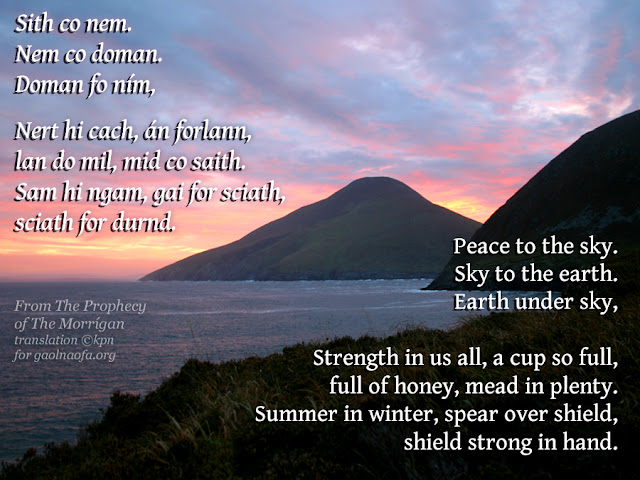
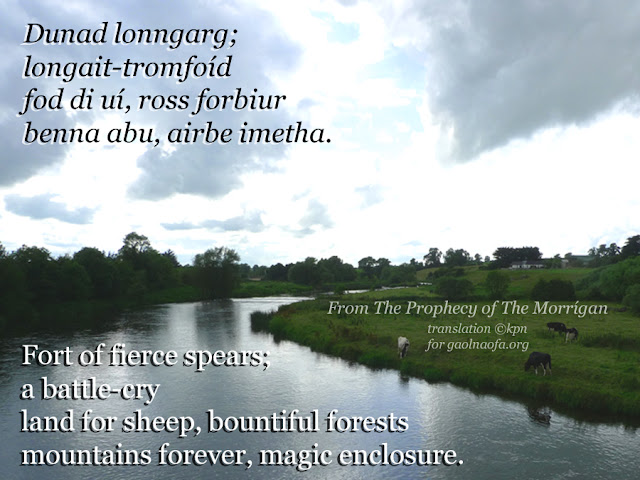
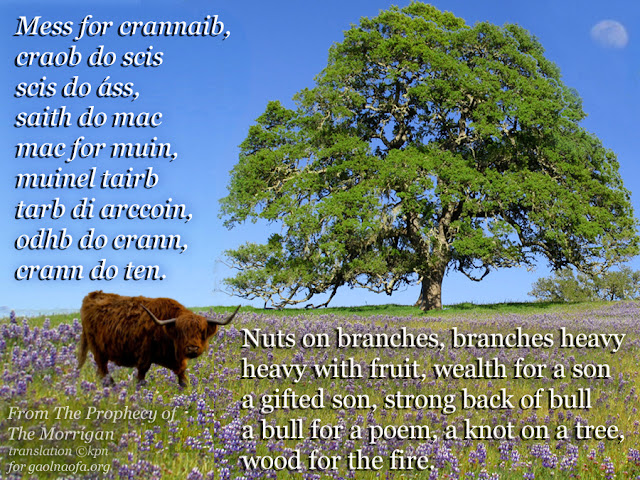
Prophecy of the Morrígan - Memes for Samhain

Here in the mountains we've had our first snow shower, and our first hard freeze, so technically the festival of Samhain is here (despite it not yet being November).

Annie and I have been continuing to make memes, and here are some I've done for the Prophecy. Links below to my full translation.

Prophecy meme – Number 1 - by Kathryn NicDhàna for Gaol Naofa 
Original image: Colin Whittaker

Prophecy meme – Section 2 - by Kathryn NicDhàna for Gaol Naofa 
Original image: Chad K

Prophecy meme – Section 3 - by Kathryn NicDhàna for Gaol Naofa 
Original images: Michael Kötter (coo) and Wikimedia Commons (background)

Prophecy meme – Section 4 - by Kathryn NicDhàna for Gaol Naofa 
Original image: Knowth.com (used with permission)

Prophecy meme – Section 5 - by Kathryn NicDhàna for Gaol Naofa
Original image: Moyan Brenn


The original Irish prayer here is from Cath Maige Tuired. 
For the full prayer in one piece, see my post from 2012, or the Gaol Naofa Memes page. For the fully-footnoted version exploring my translation of this traditional piece, see our Prayer in Gaelic Polytheism article.

In ancient Ireland, a great war is said to have taken place between the Tuatha Dé Danann and the Fomorians as they fought for the right to rule Ireland. The tale of this conflict is told in the Cath Maige Tuired (The Second Battle of Mag Tured), and the final battle took place Samhain, with the Tuatha Dé Danann being victorious.
Conflict, death and chaos are common themes associated with Samhain in Irish myth and folklore, but out of this conflict comes a resolution of peace. At the end of the Cath Maige Tuired, the Morrígan (or Badb) relates a rosc (a particular type of Irish poem, which is often written in obscure or archaic language), proclaiming victory in battle, and giving a prophecy of things to come. As Samhain approaches, it seems only appropriate to reflect on these themes, and the message of the Morrígan's words. As a prayer for peace, you might also wish to incorporate the words into your celebrations. The images collated here (five in all) each contain a section of the prayer. You can also view our video of it, which we released on our youtube channel last year:

Tuesday, September 29, 2015

Lá Fhéile Mhacha / Là Fhèill Mìcheil / Harvest

In honour of Là Fhèill Whatever, we've made an Autumn / Lá Fhéile Mhacha / Là Fhèill Mìcheil playlist, which includes several examples of earth-honouring, community traditions that survive in the present day. We have practical demonstrations of wheat-weaving (if you want to make a Cailleach figure for the harvest), the Cailleach an Dùdain (Old Woman of the Mill Dust) song, footage of the Riding of the Marches in Scotland, and of course the Seaweed Molly festival.


The Riding of the Marches is pretty clearly about boundaries - namely the practical act of checking the fences and edges of the territory, and perhaps there's also something spiritual here. At Samhain, hard choices - literally life and death - need to be made by those who raise livestock; Samhain is traditionally the time to decide how many animals can make it through the winter, and how many are going to be slaughtered for meat. At this festival, those who farm are bringing in the last of the grain, so this figures into the winter planning as well, and is clearly symbolized by the slowest person to finish the harvest having to support the Cailleach for the coming winter. It would also make sense that those with the largest fields need more time to bring all the grain in, so this tradition could be a way of recognizing that personal abundance calls for community responsibility - if you have more than you need, proper hospitality and honour leads one to want to share that abundance with those who don't have enough. And maybe having your neighbors toss the Cailleach at you is a way of making sure everyone upholds that bargain.

The Seaweed Molly rite is about giving back to the sea - making an offering of gratitude and thanks that the sea spirits have been kind this year, and not taken back (drowned) any people from the community. I also find it touching that the modern survival has these young surfers and lifeguards carrying the Molly doll (much like a Brideóg) from door to door and recieving honours and gifts for their part in maintaining community safety: Another safe year of swimming in the sea. How fitting that they then paddle out to make the offerings to the spirits on behalf of the community that they help protect.

Slàinte Mhath! 

For more detail on all of the above, see our other recent posts over at the Gaol Naofa Facebook page.

Monday, September 21, 2015

Lá Fhéile Macha

Moladh Mhacha for Gaol Naofa

As seen in our Michaelmas video, the feast of St. Michael on Sep. 29 preserves many seasonal Gaelic customs, though they are mostly the same as ones observed at Lá Lúnasa or Oíche Shamhna in other regions. Pre-Christian deities whose qualities were inherited by Michael include Macha and Manannán.

Manannán already has his own festival at Midsummer. While many of us honour Taillte at Lúnasa, and the Morrígan at Samhain, perhaps Macha also deserves a festival of her own: Lá Fhéile Macha.


Like Michael, Macha is also associated with horses and the fields, and the traditional horse races held at this time could be dedicated to her, along with the swimming of the horses, the walking or riding the boundaries of the fields, and the baking and offering of the bannock/strùthan.

The Cailleach is also relevant now due to the equinox sunrise illuminating the inner chamber at Sliabh na Caillí/Loughcrew in Ireland. The last sheaf of the harvest is called the Cailleach, and the Cailleach an Dudain ("The Old Woman of the Mill") dance is also traditional at this time.

For the traditional basis of the festival in the living Gaelic cultures, see Annie's article at Tairis: 'Là Fhèill Mìcheil'

Which deities we honour at these festivals can vary a bit with our differing bioregions, as well as which deities we have more affinity with and other factors that affect our households. Whoever you honour at this festival, we wish you a good one!

Photo collage from Creative Commons images by efilpera (horses)  and Duarte JH (field)
Text excerpted from 'Moladh Macha'
Adapted from 'Moladh Moire' [257] by KPN for Gaol Naofa
For the full prayer visit our meme page

Feel free to share this meme, as long as you link back to either our meme page or our facebook post.

Tuesday, September 15, 2015

Gaol Naofa Memeage

Those of you who follow us on social media may have seen the memes we've been creating. We've added a page to the site to archive the ones we've done so far, and where we'll be posting more in the future: Gaol Naofa Memes. We've been working with a mixture of proverbs, prayers, triads, and quatrains from various Goidelic sources, doing our bit for language preservation and providing links for further info. For regular updates follow us at our Gaol Naofa Facebook page and Twitter account.
 
Gaol Naofa – New Moon
Original image: Dawn Perry

Monday, August 24, 2015

New Video - Offerings in Gaelic Polytheism


We've been getting visual :)

More details about the offerings video on our YouTube channel, and in an update over on the Gaol Naofa website.

Gaol Naofa - Dùrachd
Photo credit: John McSporran, used under Creative Commons Licence.

We update more frequently over at our Facebook page, so if you haven't, come visit us there. :)

Friday, February 20, 2015

Mooon. Sacred.

Some Gaol Naofa website updates and another video. This is supposed to be one of those new moons that, once visible, will be larger-looking than usual, low on the horizon. Haven't seen it yet. Go look outside at sunset and see if you can spot it.


(thanks to Ryan for the title. ;) )

Sunday, February 01, 2015

Là Fhèill Brìghde 2015

This has been a busy Imbolc, so this will be brief. Here's our Là Fhèill Brìghde video. We made this last spring, so this is the first time we've had it for the festival day.


We've been continuing to work on the missing Manannán situation, and will have more materials out shortly.  For Imbolc proper, Annie got it together in the midst of it all to post Là Fhèill Brìghde links and stuff, as well as some lovely photos of Brigid's well and environs at her sanctuary in Kildare. Check 'em out, and we'll be back shortly.


Friday, January 30, 2015

Singing Manannán Home - New Video and Memes

image composite by Gaol Naofa at gaolnaofa.org

The search for the Limavady Manannán statue continues. As Gaelic Polytheists, as people involved in cultural preservation, we are continuing to assist the effort, via networking and raising the alert via the Gaol Naofa and CAORANN pages on Facebook and Twitter (Gaol Naofa Twitter, CAORANN Twitter), and now with a new video and some more memes.


For this video we have compiled some of the many, astonishingly beautiful photos of the statue and land in Limavady, County Derry, Ireland (Léim an Mhadaidh, Co. Dhoire, Éire), plus a prayer we are using to call Manannán home. This video also has the Manx lyrics synched up with the corresponding verses in the song, to better facilitate learning.

We are calling Manannán from wherever he is, to show himself in the world, and to reveal the whereabouts of the statue. If the statue has been destroyed, we will support efforts to have it replaced. But it is up to the people of Limavady, and the sculptor, John Darren Sutton. The Limavady town council has expressed interest in replacing it themselves. After all, they originally commissioned the piece as part of their sculpture and heritage trail. If their budget will not adequately cover a replacement, we have also promised to help with any needed fundraising. While it's impressive to see the worldwide attention on this, those of us in the diaspora need to remember that any fundraising - if it is even necessary - needs to go through the local community in Ireland, specifically the Limavady community, and not through any individual from outside that community.

These amazing photos were largely collected via the Facebook group, Bring back Manannan Mac Lir the Sea God.  All the photographs in the video and memes are used with permission from, and gratitude to, the photographers (see the video credits for the full list of participants). Feel free to share them to keep the search for the stolen statue on the front burner.

The theft continues to get a great deal of press in Ireland and worldwide, and in specialized media like The Wild Hunt, who quote Annie and mention our work with Gaol NaofaCalling Manannan mac Lir Back Home.  

See the update on the Gaol Naofa site for full details: Where is Manannán?

text copyright ©2015 Kathryn NicDhàna for Gaol Naofa and gaolnaofa.org

Monday, January 26, 2015

Search for Stolen Manannán Statue Continues

Gaol Naofa - Song for Manannán
Photo copyright © David Wright, used with permission. Song traditional Gaelg.
See our Midsummer video for the tune and pronunciation. Memeage by Kathryn NicDhàna


By land and sea and helicopter, by beaches, trails and roads, Irish people are searching for the stolen statue of Irish sea god Manannán mac Lir.

"Sea god Manannán mac Lir still missing after police search"

Locals in Limavady have issued a Missing Persons Alert:
Gaol Naofa - Missing Sea God
DESCRIPTION - A well known six foot tall striking local male with an athletic build. He has shoulder length hair held back with a headband and has a beard. We have concerns for his health in this weather as he is bare chested with only a thin shawl held at the neck with a decorative clasp to keep his top half warm. Evidence at the scene suggests he has injuries to his feet!

He is a very striking fella so if you have seen him please let us know.

Last seen standing at Gortmore viewing point Binvenagh Mountain around the 21st January looking out to sea.

Locals have searched the area and have completed an overflight to check he was not dumped in the area.
And a local funeral director is offering a reward for the statue's return.

On the polytheist front, we are making offerings to him, and singing his traditional songs. We are asking Manannán to help the police and citizens who are searching, and to spur someone who has information and is feeling uneasy to do the right thing and come forward with the truth.

Gaol Naofa - Manannán Meme
And a smaller version
While some are suggesting a co-ordinated, timed effort for the night of Jan 31 - Imbolc, this coming Saturday - we are not waiting for a particular night. We are on this right now.  Manannán is a guide and guardian of our Gaelic Polytheist and Gaol Naofa community, so we are singing to him every day and night. As we have been since this news broke and will continue to do until justice is done and he is brought home.

The many people who love this statue, be they polytheist, Christian, or any other religion or lack thereof, are sharing their photos on the Facebook page, Bring back Manannan Mac Lir the Sea God. While most are those who just love the statue as art and history, others are sharing altar photos as well.

This Manannán playlist has a video of sculptor John Darren Sutton creating the statue from the clay on up, along with local reactions to the theft (here on YouTube for those who can't get Northern Ireland TV news broadcasts) and more songs for him. For the tune and pronunciation of the Manx song in the meme above, see our Midsummer video in the same playlist. We will be adding more Manannán information and materials to the playlist as the situation develops.

Let's bring him home!


Wednesday, January 21, 2015

Ireland: Statue of Celtic Sea God Manannán Stolen


"Those who made off with the sea god left a wooden cross with the words 'You shall have no other gods before me' in its place." - Fiona Murray BBC News NI, Game of Thrones sculptor's sea god statue stolen from mountain.

This statue of the Celtic sea god, Manannán Mac Lir is a religious icon. People have been leaving offerings there, tourists make pilgrimage, photographers have spread his image worldwide, and local people still tell the stories of his protection of the land and relationship with the sea and local weather patterns.

photo via BBC Northern Ireland
Apparently, some people who pretend to be Christians don't like this.

Whether this was done by art thieves looking to lay a false trail, or by intolerant people who betray their supposed lord's message of tolerance and love, this is a hate crime.

Manannán is the guardian of the land on the Isle of Man and in other Gaelic areas. He is also one of the founding forces, guides, and guardians of the Celtic Reconstructionist and Gaelic Polytheist communities. For him to be out in Nature, high on a mountian, overlooking the sea, was profoundly moving, and those who have stolen him have desecrated something sacred.

If this was really done by those who claim to be Christians, this is a relgiously-motivated hate crime against a minority spirituality. For Irish people, even those who consider themselves Christian, or of another faith or no religious belief, Manannán is part of our history and culture, and this is a crime against all the Irish people who still respect history, culture, and the spirits of the land, sky and sea.

Our prayers are with the sculptor and all the people - local and worldwide - who are shocked and hurt by this crime. Our prayers are also with everyone investigating this and searching for the statue, that they quickly recover the statue and bring the criminals to justice.

So be it. Sláinte Mhaith.


If you have any information on this crime or the whereabouts of the stolen statue, please speak out. Talk to the members in your community, use social media, and let's take care of this. Feel free to reuse this meme if you like. This was a deliberate act of desecration, involving several physically strong people, a lot of noise, power tools, several hours at the statue, a truck or van, and planning. Someone who doesn't agree with this hate crime has to have seen or heard something. We pray they come forth now.

Sculpture by John Darren Sutton
Top photo courtesy the artist via his facebook page
Photos for "Missing" meme and Aurora Borealis copyright Neil Maroney, who I hope will understand re-use with credit, given the situation.

ETA: For more on Manannán, and a song to call him home, I am reposting our video about him that we released last summer.


If you're looking for the lyrics to sing along, the first part of the track is a traditional Manx song called "C'raad ta'n Ree?" which you can find a version of on the Gaol Naofa website: http://www.gaolnaofa.org/library/music/craad-tan-ree/

The second part is a song/prayer, which Breesha Maddrell notes is still popular with kids today: https://thesession.org/tunes/12899

Monday, December 15, 2014

Grianstad an Gheimhridh (Winter Solstice) and Hogmanay

Fàs is gnàths is toradh
growth, tradition, success 
Image copyright ©2014 Kathryn Price NicDhàna
On Hogmanay morn, we gather water from under the bridge, which became
"a dead and living ford" the first time we brought a deer carcass across,
and which has now witnessed the passage of several of our beloved dead. 
photo copyright ©2014 kpn

The winter snows have come, the nights are long and cold. We gather with our loved ones and hold each other close.

Yes, we've made more Gaol Naofa videos :)  Annie took point on these, and we have her lovely photos from Newgrange and other sacred sites in Ireland and Scotland. For those of Scottish heritage who may not have known why secular/calendar New Year's Eve is a big deal in our families of origin, we have the answer: Hogmanay.

Hogmanay is a time for saining the house and welcoming in the New Year. While the dour Celtic mindset supports the idea of beginning the year at the falling darkness of Samhain, there is something about the Winter Solstice sunrise that lights a spark in my heart: The longest night of the year is broken by the rising sun, shining down the long passage at Brú na Bóinne, bringing light to the ancestors and announcing that now the days will grow longer, bit by bit, until warmth and green return to the land.


As a people who see time as a circle, and spirit as eternal while only matter rises and falls, dies and is born again, I'm not particularly interested in the debates about which day is "The Celtic New Year." Arguments can be made for pretty much any point in the cycle, depending on one's work, where one lives, and which deities and spirits are most important to us. 

The phrase  "Fàs is gnàths is toradh (Growth, custom, and fertility)" is traditionally said by the head of the household as they bring a twig from a local fruit-bearing tree inside to the breakfast feast. It is customary to sain one another and entire house at this time, with water from "a dead and living ford" (a watercourse over which both the living and dead pass), and to fill the house with so much juniper smoke that everyone begins to cough. This means that all your smoke alarms will also be going off. I consider it part of the festivities. But any of the alarms that are hooked into a security system will need to be turned off. Trust me, your local firefighters will appreciate being spared the false alarm. If you forget and they show up anyway, you can consider it a bizarre variation on first-footing. Make sure to offer them abundant hospitality.


As everyone is coughing and the alarms are blaring, it is time to fling open the doors and windows and welcome in the brisk, cold air of New Year's morning. We do a brief welcome and prayer in Gaelic at each door and window we fling open, welcoming the household's guardian spirits and the qualities we hope for in the coming year. It is customary at this time for the hearthkeeper of the household to offer everyone a nip of whisky. As a sober household, we use strong, alder-roasted or hazelnut coffee and espresso chocolate.

Then everyone sits down to a big breakfast, which symbolizes the abundance we hope for in the coming year.

Good Hogmanay to our Gaol Naofa family and extended community!
Fàs is gnàths is toradh!


For an abundance of lore and more suggestions for celebrations, see Annie's collection of links to her articles and research. 


Tuesday, September 30, 2014

Samhain

And we have... another video. This time on Samhain, with songs, poems, prayers and activities:


Annie did a good writeup about the videos, so I'll just send you her way. We also have some updates on the Gaol Naofa page.

 Blessed Samhain to you all!

Saturday, July 26, 2014

And... MORE videos

Annie and I have been busy. Thanks also to our Gaol Naofa community, who have shared their photos and music, posed for photos, made coffee, driven us to wifi spots while we stared at our laptops, given vital feedback and spotted typos. We're having fun doing these, and have more to come.

This batch includes Lúnasa /Taillte, The Prophecy of the Morrígan, and La Fheill Micheil. For more about the videos, see our blurb on the website, discussion in our various online communities, and our channel itself (notably the Festivals playlist).

Slàn!

Lúnasa  / Taillte


The Prophecy of the Morrígan


Là Fhèill Mìcheil (with customs for Autumn, Lugh, Manannán and Macha)


ETA: Annie goes into more background on the conditions of peace at Lúnasa, and the importance of this tradition in her post.

Tuesday, July 08, 2014

Gaelic Polytheist Videos - Lá Fhéile Bríde, Là na Caillich, Bealtaine, Áine agus Grian, & Manannán

We've been busy at Gaol Naofa! Along with all the usual activities of summer, we've made some more videos. Here are five more in the series, focusing on the seasonal and local festivals.

We had fun making these, and hope they can provide a brief intro to the subject for those less inclined to read a 90 page article or scholarly book. Additionally, we've dedicated our efforts to capturing the essence of each topic in visuals and music in a way bare words cannot. After all, the lore says we must drink from all five streams of knowledge, and engage all the senses in absorbing the sacred.

Images are mostly of the sacred sites and activities associated with each of the deities, spirits and festivals. Music is either an old, traditional song on the topic, or a contemporary version of traditional lyrics and tunes. Traditional prayers are included. Some of these images are old, archival photos, others were taken very recently by our members in the Celtic Nations and diaspora (in some cases photographed expressly for this series). Much gratitude to all our friends and relatives who went trekking with their cameras in tow!

Feel free to share!

Lá Fhéile Bríde — The Festival Day of Bríd
As the sun sets on the last day of January, the goddess Brigid walks the land, bringing the first stirrings of spring. Even if the ground is still covered in snow, the earth begins to stir from her long winter sleep.


Là na Caillich — The Day of the Hag
Spring is starting to happen around us, and the Clumsy Old Woman who Shapes the World is stirring up the last of the winter storms, and considering lying down for a bit of a nap. Sometimes when she does this, she accidentally creates a river or loch. Other times she drops stones she's carrying and, Ooops, another mountain range appears. She's had a lot on her mind, and wants to take a break. 


Bealtaine
In the Celtic lands, the summer is here. When the hawthorn blooms, it's warm enough to move the flocks and the herds, and hold bonfires welcoming the light half of the year. Readers of this blog will recognize the song here. 


Midsummer — Áine agus Grian
The Celts do not have a "sun deity" in the way Classical mythology would frame it. Instead, our deities and spirits are multifaceted, with full personalities, like the people they watch over, like the ancestors some of them once were. (And still are, for many of us.) In the Gaelic areas, as in most Celtic cultures, the fire festivals of Samhain, Imbolc, Bealtaine and Lúnasa are the major festivals. Activities and beliefs connected with the solstices and equinox tend to be based either on older, pre-Celtic remnants that survived in some form as local festivals, or on imports that came with the Norse and were syncretised with local beliefs and customs. Not all communities acknowledge these solar phenomena, at all, but those that do tend to associate them with beloved local spirits, often those of sovereignty.


Manannán — Paying the Rents at Midsummer

Mac Lir, son of the sea, patron of the Isle of Man, guiding spirit of Gaelic Polytheism. Well, one of them. But Manannán has shown an especial interest in the development of Celtic Reconstructionism, and I am happy to have this lovely video about him and his work, an homage and thank you for the guidance he's provided us over the decades.

Wednesday, March 12, 2014

Lá Fhéile Pádraig / "Saint" "Patrick's" Day, 2014

Tis the Season...

For those of us with Irish heritage in the diaspora, this is one of the most awkward and uncomfortable times of the year. While we are relieved at the lengthening days and warming weather, glad to have survived another harsh winter, we are also horrified at the debacle that is American and Canadian Saint Patrick's day.

As I write this, the riots have started. In one college town this weekend, thousands of students celebrated their idea of St. Patrick's day by drinking themselves sick, puking on their violent green t-shirts, assaulting one another and hurling bottles and rocks at the riot police that tried to stop them from harming other civilians. This behaviour is shameful, and as an Irish-American it makes me very sad and dismayed to see this happening yet again in the name of "Irish pride." Of course, I think only a minority of those rioters even have Irish heritage. And what heritage they have, they dishonour.

As I've written about before, to attend some of these awful festivities can put your safety in jeopardy. And the thing is, these drunken blowouts have nothing to do with being Irish.

In past years, we've done our best to avoid the whole thing, or to quietly educate via online discussion and memes.

This year, we've decided to get proactive.


We're pleased to present an article debunking some of the myths around St. Patrick's Day: Pagans, Polytheists, and St Patrick’s Day, as well as two videos on the topic.

Video one is a general introduction to the problems with the stereotypes, and video two is directed more specifically at the myths around Patrick himself, and the misinformation spread by both Pagans and Christians.


Our Gaol Naofa video channel has been in the works for a while now. Treasa made our first videos two years ago, then we stalled out a bit on getting more done. This year we've tried to use our anger and frustration around the whole St. Paddy's thing to motivate us to finish up some projects and counter the misinformation. Check out our playlists for other videos that should be of interest to Gaelic Polytheists, or anyone interested in Celtic Reconstructionism and Gaelic cultures in general. If you like what you see, feel free to subscribe, as more is in the works.

As we say in the videos, we welcome the spring, and celebrate the Hag who turns the seasons. She, and the Earth, are renewing themselves now, and we honour her.

We also honour our ancestors who worked so hard to survive oppression, famine and exile. The St. Paddy's parades in the diaspora initially began as cultural celebrations - a day for members of an oppressed ethnicity to gather together and celebrate their survival against the odds. It was only after our recent ancestors "became white" and rose to power in the police departments and mainstream politics that the marches became drunken bacchanals, with little to no connection to anything traditionally Irish.

We hope you enjoy these contributions, and find them useful in debunking the myths that surround this season. For more on our recent projects (such as our in-depth article, “Children and Family in Gaelic Polytheism”), see the Gaol Naofa site. Sláinte Mhaith.

Friday, January 18, 2013

Breath of Life: The Triple Flame of Brigid - New Article from Gaol Naofa

As noted when we announced our website relaunch, we at Gaol Naofa have a number of writing projects in the works, which were not quite ready when we relaunched the site, but that we will be releasing over the next few months and years. Here is one of them:

Breath of Life: The Triple Flame of Brigid

In Gaol Naofa, our Gaelic Polytheist community, we recognize and honour multiple manifestations of the Flame of Brigid. Based in the Old Irish lore, in the wisdom found in the living Gaelic traditions, (i.e., the folkloric customs, songs, tales and beliefs found in the areas where Gaelic, Irish and Manx are still spoken, and where these traditions have been handed down most faithfully) and what we have found in our own experiences, we see her sacred flame as threefold, and illustrated as either three flames rising from a cauldron, or as three concentric circles:

1. The sacred, cloistered flame which is tended by women only.

2. The hearth flame, which is tended by the bean a tighe ('mistress of the house') or fear an tighe ('man of the house') who kindles the household flame and repeats prayers and blessings over it for the protection and well-being of their family, as well as petitioning Brigid on behalf of the family.

3. The community, festival flame which is lit by whichever individual or group is appropriate for that particular ceremony or gathering.

Each flame of Brigid is also a center in and of itself: The festival flame is the center of a ceremony, the hearth flame the center of a household and family, and the cloistered flame the center of a shrine and community. Fire's ability to create, destroy, transform and inspire has always fascinated the Gaels and we perceive it to be something divine and otherworldly. In reconstructed, Gaelic Polytheistic cosmology, fire is perceived to be the center of land, sea and sky: a source of inspiration (imbas), a place where we commune with one another, and where we speak, and listen, to the deities, ancestors, and spirits of nature.

Read more...
Three circles cauldron copyright ©Kathryn Price NicDhàna for Gaol Naofa

Brigit búadach, Lethan breo. Brigit búadach, Bethad beo.

Thursday, December 20, 2012

Sith co nemh, bid sír nae. Sith.

 
Winter Solstice sunrise at Brú na Bóinne

Sith co nem.
Nem co doman.
Doman fo ním,

Nert hi cach, án forlann,
lan do mil, mid co saith.
Sam hi ngam, gai for sciath,
sciath for durnd.

Dunad lonngarg; longait-tromfoíd
fod di uí, ross forbiur
benna abu, airbe imetha.

Mess for crannaib, craob do scis
scis do áss, saith do mac
mac for muin, muinel tairb
tarb di arccoin, odhb do crann,
crann do ten.

Tene a nn-ail. Ail a n-uír
uích a mbuaib, boinn a mbru.
Brú lafefaid
ossglas iaer errach,
foghamar forasit etha.

Iall do tir,
tir co trachd lafeabrae.
Bidruad rossaib, síraib rithmár,
'Nach scel laut?'

Sith co nemh,
bidsirnae.
.s.


Peace to the sky.
Sky to the earth.
Earth under sky,

Strength in us all, a cup so full,
full of honey, mead in plenty.
Summer in winter, spear over shield,
shield strong in hand.

Fort of fierce spears; a battle-cry
land for sheep, bountiful forests
mountains forever, magic enclosure.

Nuts on branches, branches heavy
heavy with fruit, wealth for a son
a gifted son, strong back of bull
a bull for a poem, a knot on a tree,
wood for the fire.

Fire from the stone. Stone from the Earth
wealth from cows, from the womb of Boann.
From the mist comes the cry of the doe,
a stream of deer after springtime,
corn in autumn, upheld by peace.

A warrior band for the land,
prosperous land, reaching to the shore.
From wooded headlands, waters rushing,
"What news have you?"

Peace to the sky,
life and land everlasting.
Peace.

From the Prophecy of An Morrígan, in "Prayer in Gaelic Polytheism". The original Old Irish, as a solid block of text with few line breaks, is in the public domain; this arrangement and translation copyright ©2012 Kathryn Price NicDhàna for Gaol Naofa. See the article for extensive footnotes delineating how I arrived at this translation. Any errors in translation are my own.

And Check out Treasa's excellent writeup on some of the Gaelic sacred sites and spirits associated with this time of year: Celebrating Grianstad an Gheimhridh (The Winter Solstice)

Wednesday, December 12, 2012

Gaol Naofa Site Relaunch: New FAQ and Articles

Gaol Naofa - Gaelic Polytheist Lifeway
Over the past few years I have been increasingly collaborating with my dear friends and colleagues in Gaol Naofa, our Gaelic Polytheist organisation.  While it may seem we've been quiet for a while, we have actually been very busy over the past few years, and are now ready to release some of the work we've been doing.  The material now uploaded to the site is well over a book's-worth of new material. Even just combining the new FAQ with the associated articles, it's the largest amount of GP or CR text I've been involved in publishing since the release of the CR FAQ. All told, it's also more substantial than that earlier work and, since this is a statement from one organisation, more unified and better footnoted.

The Gaol Naofa FAQ
The link above will take you to the intro page; click on the link for the pdf file (we had to put it in a pdf because it clocks in at a good 90 pages long, and it's really the only way to make the index workable without breaking up every section the way we did with the CR FAQ website). The GN FAQ has been substantially expanded from the earlier version and outlines the nitty gritty of our organisation and our vision for it. It also goes into some of our beliefs and outlooks on certain areas. In that sense it might be of interest to Gaelic Polytheists in general, but we hope it's clear that the contents of the GN FAQ (as with everything else we've done) speaks to our own points of view as an organisation and no one else's. Even though some other groups might overlap with us in places, that doesn't mean one size fits all.

Then there's:

Rowan and Red Thread: Magic and Witchcraft in Gaelic Cultures
Again a pdf, weighing in at a more modest, but still substantial, 57 pages. We cover the general gist of the article in some of the questions in the FAQ, so this offers a bit more of our thoughts on this, with plenty of references and historical goodness. It's a huge area, though, and this is really only scratching the surface. One of the things we tackle in this is the use of terminology in both historical and contemporary communities, and why we in Gaol Naofa do not call ourselves "witches." Anyone interested in joining our discussion groups should at least look over the FAQ and (if they want lots of supporting data) this article, so as to understand what we mean by all of these terms, how these terms are and aren't used in our organisation, and what we will think you mean if you use them.

And then we have:

Prayer in Gaelic Polytheism
Another pdf but a bit shorter than the two above. The title is fairly self-explanatory; we go into how we approach prayer and how we make our prayers, the kinds of sources we look to and how we deal with both the gifts and the problems those sources can present. Some examples of prayer are given, along with new translations of part of The Prophecy of the Morrígan and some prayers from the Carmina Gadelica. A suggested reading list is included as well.

As you'll see on the articles page, we have slightly updated and added to the Offerings article, and Treasa and I have another substantial article ready to go once we stare at it for a bit longer with our Editor's Hats on. Elsewhere on the site you'll find that the reading list has been expanded, and the "About" pages have been overhauled too.  To celebrate five years of the organisation, Treasa has given the website a bit of a makeover with new headers and icon thingies.

A big thanks, once again, to everyone who helped us out and supported us during the first, second and however many final drafts we went through on these pieces, as well as for your support and feedback in general.

On a personal note, I would like to particularly thank the members of the council, the advisory network, and all the members and allies who have been so supportive and collaborative in the past five years. In particular, Tomás for founding Gaol Naofa, and for not giving up when I kept being vague and noncommittal about joining. And of course Treasa and Annie for making these writing projects a joy instead of a struggle. You guys came along at a time in my life when I was at a crossroads and not sure where I was going. Thank you for your determination, dedication and perseverance. Slàinte Mhath!

P.S. Members will note that there is a new, members-only, Gealach Ur Rite, which has been completely rewritten to include traditional liturgy, ritual, and an accompanying article on the moon in Gaelic cultures. This will be available to renewing members in the new year.  We plan on opening up our membership process for new members after the activity of the Winter Holidays subsides a bit. In the meantime, you can get to know members of our community on our public discussion group, where all who are interested in Gaelic Polytheism are welcome to come and chat with us, whether or not they are members of Gaol Naofa. You can also stay abreast of updates and links via our new Facebook Page.


Read the full announcement here: Gaol Naofa Relaunches and Celebrates Five Years
I also cribbed some of the text for this from Annie's post: New Stuff